FoldEngine Stabilized.

Sample outputs

What real outputs would your team receive?

Trial Probe examples show bounded decision reports: findings, evidence gaps, a recommendation, a decision, and the next move. FoldEngine Runtime examples show governed evidence, candidate artifacts, receipts, and review surfaces from offline work. All samples here are representative public examples — not private work, and not live backend responses or self-serve report downloads.

Runtime walkthroughs

Product demonstration by repository type

These walkthroughs show how the runtime is expected to move through input, construction, engineering, validation, evidence, review, and output for realistic engineering cases.

Flagship example

Governed Repository Diagnostic

A full customer-facing case study showing what a CTO or engineering director receives in the first month: mounted repo intake, construction workspace outputs, governed engineering planning, development packaging, validation posture, evidence bundle, and review handoff.

Open walkthrough Source unchanged throughout Review remains human-controlled

Python microservice

Repository discovery → governed validation

Input: mounted Python service repo. Construction: blueprint + acceptance. Engineering: bounded candidate. Validation: pytest/ruff route if available. Output: evidence + review package.

Node API

Stack gate → projection export

Input: Node or TypeScript service. Construction: dependency and acceptance mapping. Engineering: governed patch candidate. Validation: npm/tsc route if supported. Output: receipts, review package, export candidate.

.NET / Java backend

Version compatibility → development lifecycle

Input: enterprise backend repo. Construction: requirements and dependencies. Development: implementation, tests, docs, architecture impact, release-note planning. Output: governed development package.

Mixed repository

Convention discovery → evidence route

Input: polyglot repo. Construction: identify bounded slice. Projection: problem, requirement, and dependency graphs. Output: next safe move with explicit ambiguity preserved.

Regulated banking change

Review-heavy delivery posture

Input: governed change request. Construction: acceptance and review mapping. Evidence: receipts, validation, continuity, export posture. Output: review handoff without compliance overclaim.

Legacy modernization

Takeover → future work package

Input: risky legacy repo. Takeover: discovery + stack posture. Construction: bounded modernization slice. Output: future candidate contract, evidence plan, and readiness gaps for the next phase.

Entry diagnostics

Trial Probe Examples

Sample bounded decision reports.

Sample bounded decision reports and continuity deliverables. Static public examples only — each names the assessed surface, evidence boundary, and supported claim where practical.

Probe Reports

Point-in-time governed findings

Static public examples only.

Public example

Evidence-backed

Assessment: Mature library / paid diagnostic

Flask structure alignment

Repo: pallets/flask

Assessed surface / question

Product surface: public Flask repository structure. Decision: is it suitable for a bounded structure-alignment probe?

Short finding

The public repository surface has enough visible structure to support a focused docs/examples/tests/src alignment check.

What was checked

Public repo overview, docs/tests/examples/src path shape, visible evidence, and the bounded approved probe path.

What was not checked

Full code review, security audit, legal/compliance review, private systems, repo code execution, or exhaustive dependency audit.

Recommended next step

Run a focused docs/examples/tests/src alignment pass on one representative feature.

Public example

Supported claim check

Memory Palace claim-evidence

Repo: milla-jovovich/mempalace

Example question

Is the public Memory Palace retrieval benchmark claim supported by committed evidence?

Short finding

Evidence-backed committed artifact alignment: raw LongMemEval rows 500, raw LongMemEval Recall@5 0.966. This is not independent scientific proof.

Plain-language read: this sample shows how the probe surfaces whether benchmark-style claims have enough surrounding evidence to be trusted.

What was checked

Public repo surface, committed benchmark result artifact, benchmark documentation, and retrieval implementation anchors.

What was not checked

Independent benchmark rerun, full code review, security audit, legal/compliance review, private systems, or permanent stability.

Recommended next step

Tighten stronger rerank/perfect-score wording so it names exact artifact, split, and metric.
Public example

Stale trust signal

Assessment: Stale-trust / library-package choice

Create React App stability signal

Repo: react/create-react-app

Assessed surface / question

Product surface: CRA as an app-starting toolchain choice. Decision: can a highly familiar public repo still carry stale stability signals after its ecosystem moves on?

Short finding

Create React App is a public example where popularity, tutorials, and legacy familiarity outlived the current recommended path for new React apps.

Chosen because it demonstrates what happens when trust signals go stale around a once-popular project.

What was checked

React deprecation guidance, public GitHub repo state, React 19 breakage discussion, and documentation drift signals.

What was not checked

Private apps, repo code execution, maintainer intent, full migration planning, or security review.

Recommended next step

Create a migration decision receipt that classifies the app type and chooses a framework or modern build-tool path.

Static sample

Popularity evidence

Assessment: Popularity signal / repo trust context

Star Support Probe

Repo: psf/requests

Assessed surface / question

Product surface: one public GitHub repository popularity/support signal. Decision: does the visible star signal line up with surrounding public evidence?

Short finding

The sample report shows popularity support as a bounded evidence comparison, with score drivers, evidence gaps, and a safe next step.

Boundary

This report does not determine whether stars are artificial, purchased, automated, fraudulent, bot-driven, scam-related, or owner-intent related. It compares visible popularity to surrounding public evidence.

What was not checked

Private systems, code execution, full due diligence, security review, or live public endpoint execution.

Continuity deliverables

A report answers the moment. The ledger remembers across entries.

A delivered report becomes a ledger entry after delivery approval. The project's Stability Ledger is the running history across those entries: what was checked, what recommendations emerged, which decision applies, what is waiting on review, and what evidence moved the state forward.

The sample below uses fake/internal/sample data only. It demonstrates continuity across repeated probes, not an account area, unattended delivery, or private client publication.

Visual gallery bands

Expanded service samples

AI, dependency, and stability-signal examples.

Probe reports AI Code Stability Dependency Watch Continuity deliverables

Paid Deliverable v1

Seed-bearing package

Static layout sample · fake/internal data only

Shows how a governed probe produces bounded recommendations, a proceed/hold/block decision receipt, and a review-ready next-step order alongside findings and a Stability Ledger summary.

Stability Ledger sample

Demo continuity trail

Data: fake/internal/sample data only

A static example showing how repeated probes can record what changed, what improved, what regressed, and the next recommended move. This is not an interactive account area or self-serve delivery feature.

AI Code Stability Probe · CA$500

Target shape: AI-assisted codebase

Rewrite crisis prevention

Repo: ruvnet/RuView

See how a governed probe turns an AI-assisted repo from "it seems to work" into bounded findings, recommendations, a decision receipt, and an ordered stabilization plan. This sample checks for generated-pattern drift, claim-to-artifact traceability, and stabilization debt.

AI Stack Audit · CA$1,000

Target shape: Stack-surface diagnostic

AWS Pydantic Agents boundary

Repo: aws-samples/sample-serverless-pydantic-agents

A bounded stack-surface diagnostic that turns stated boundaries into a next-move checklist — not a security audit or production certification.

Dependency Watch · CA$1,500/qtr

Target shape: Dependency trust / dependency-heavy app

Gemini SDK deprecation

Repo: google-gemini/deprecated-generative-ai-python

Official SDK deprecated but still installable on PyPI. Trust decayed while the package remained available. Dependency Watch becomes more valuable across repeated ledger entries: each run can compare what changed, what stayed risky, and what next move is now supported.

Stability-Signal subtype · CA$500

OpenSearch Go maintainer call

Repo: opensearch-project/opensearch-go

Official namespace, transparent maintainer capacity disclosure. This is a Stability-Signal governance seam example, not a new top-level service.

Custom / Stability-Signal subtype

Home Assistant install pruning

Project: Home Assistant

Active project narrowed install methods because support burden exceeded benefit. This is a Custom / Stability-Signal example, not a new top-level service.

Free First Probe · Free

Target shape: Routing / fit-check entry probe

RuView fit check

Repo: ruvnet/RuView

A no-cost fit check that routes an AI-generated Chrome extension to the AI Code Stability Probe, with visible evidence and a clear next move.

Receipts / Supporting Artifacts

Evidence boundaries stay attached

Summary receipts and evidence-boundary anchors accompany report samples.

Compare lanes

Trial Probe vs FoldEngine Runtime

Trial Probe FoldEngine Runtime
Entry diagnosticOperational runtime
One assessmentOngoing governed work
Probe reportEvidence and receipt chain
RecommendationGuided execution and review
Hosted entryOffline runtime

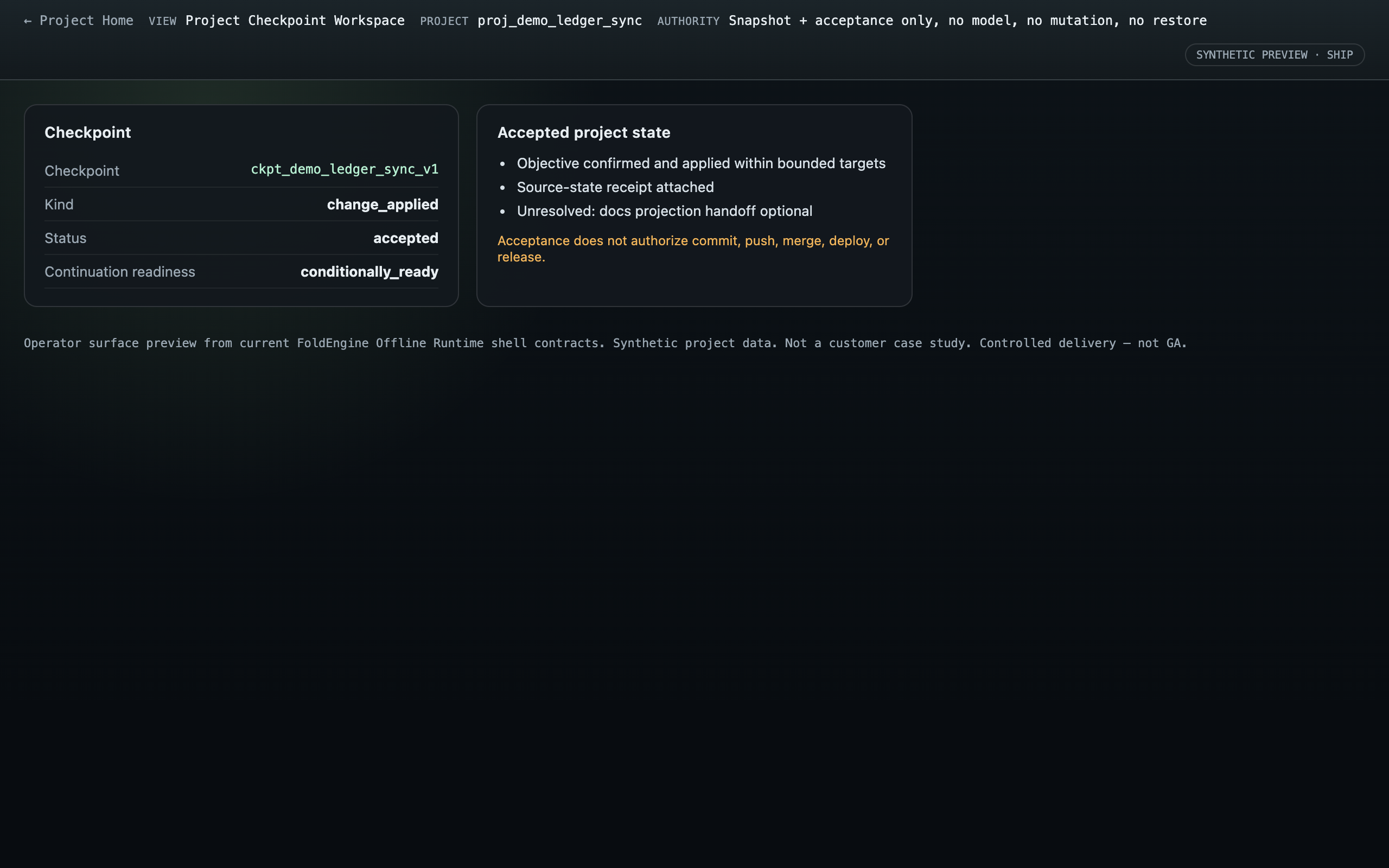
Runtime governed outputs

Runtime Output Examples

FoldEngine Runtime produces governed evidence, candidate artifacts, receipts, and review surfaces. The examples below illustrate the kinds of outputs a team receives during governed work. Examples are representative candidate outputs. They remain subject to review.

Runtime output example

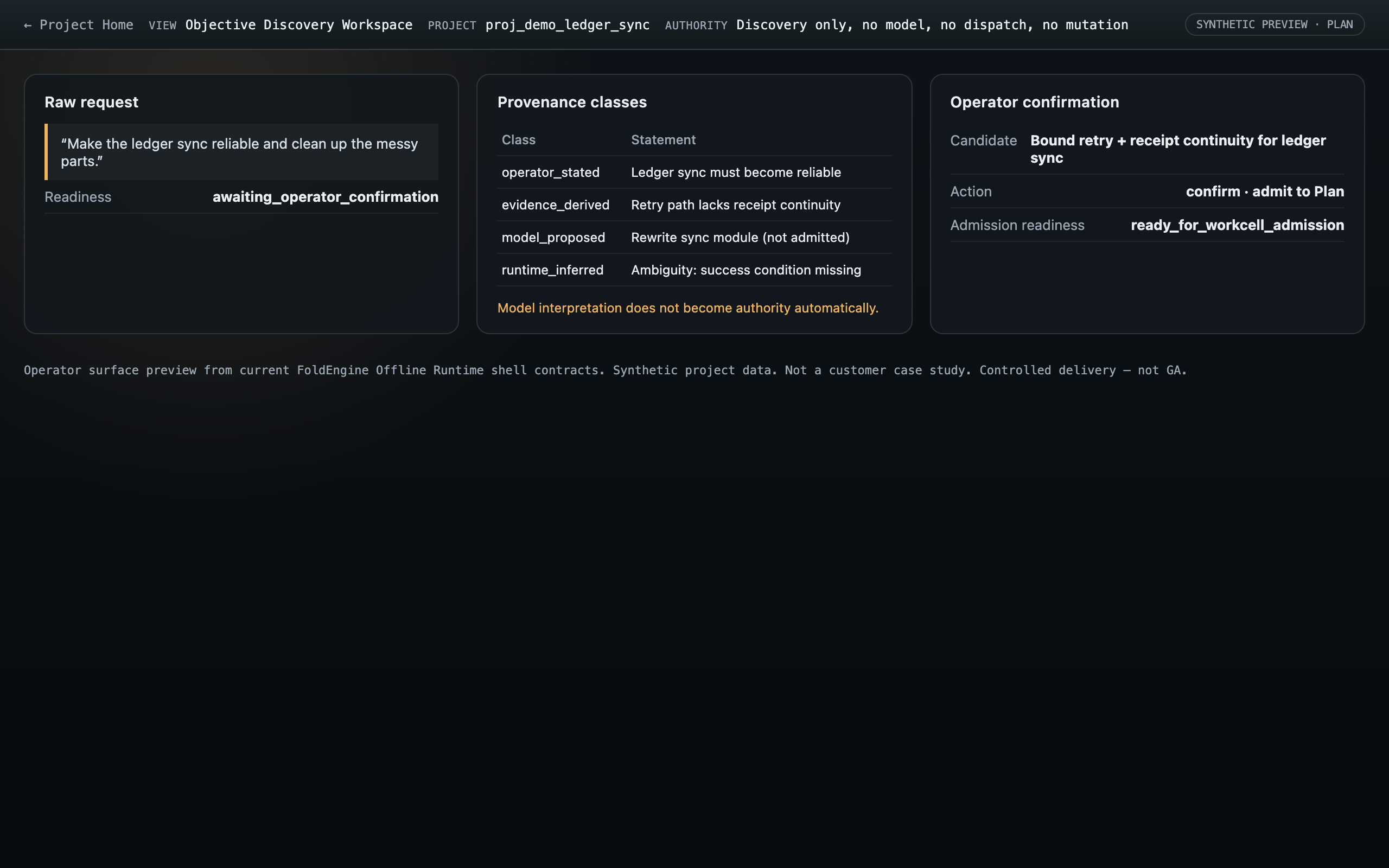
New Project Intake Summary

Question: How does FoldEngine capture a new project?

Runtime surface: New Project Guided Intake

Example output

  • Normalized requirement
  • Bounded objective
  • Known unknowns
  • Construction handoff candidate

Why it matters: Teams see intent captured before any build work begins.

Authority: No implementation has begun.

Runtime output example

Construction Package

Question: What does shaped work look like before the workcell?

Runtime surface: Construction Workspace

Example output

  • Problem shape
  • Blueprint
  • Acceptance criteria
  • Slice plan

Why it matters: Reviewers inspect planning candidates before bounded execution.

Authority: Planning candidate only.

Runtime output example

Repository Takeover Summary

Question: How does Runtime govern an existing repository?

Runtime surface: Repository Takeover Wizard

Example output

  • Protected source posture
  • Workspace trial record
  • Evidence from inspection
  • Next governed action

Why it matters: Teams classify the next safe move without mutating source.

Authority: Protected source remains unchanged.

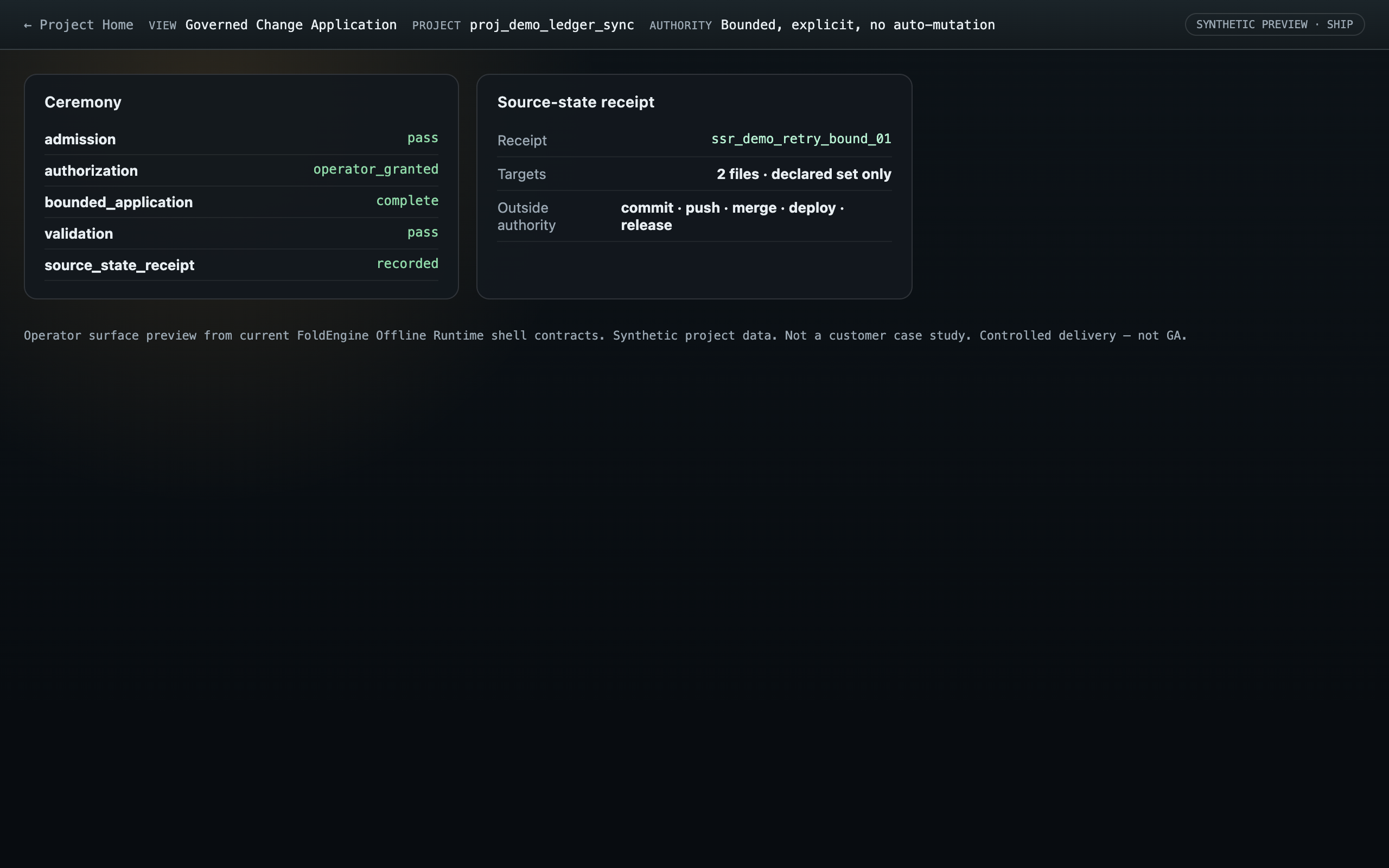
Runtime output example

Formal Review Decision

Question: What does review look like before a boundary crossing?

Runtime surface: Formal Review Decision

Example output

  • Decision required
  • Supporting evidence
  • Review status
  • Export boundary

Why it matters: Review happens with evidence attached — not as a hidden approval step.

Authority: FoldEngine supports review. Humans approve.

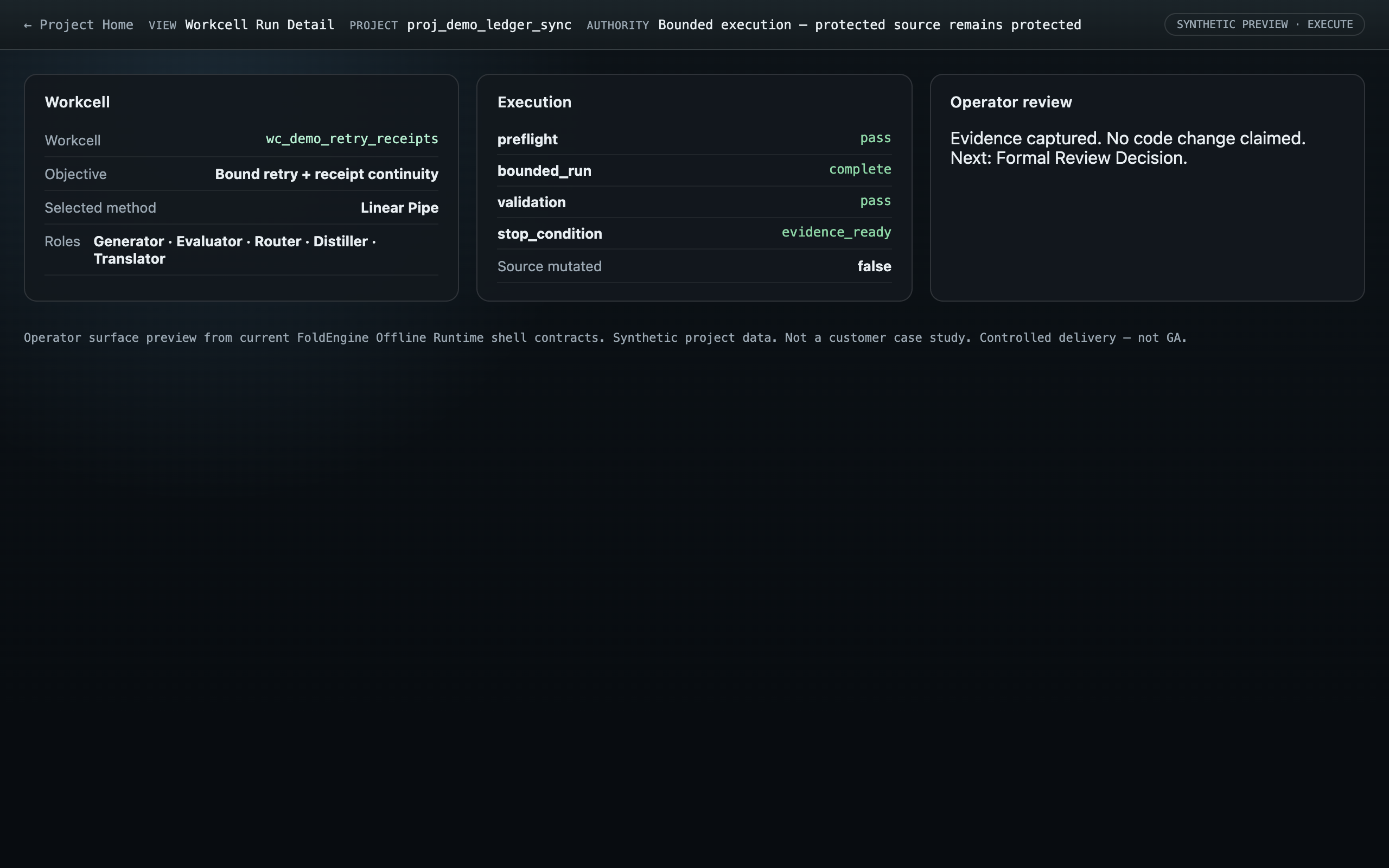
Runtime output example

Evidence and Receipt Summary

Question: What evidence does a governed run produce?

Runtime surface: Workcell Run Detail

Example output

  • Provenance
  • Receipts
  • Continuity
  • Export candidate

Why it matters: Decisions trace back to inspectable proof — not narrative alone.

Authority: Evidence supports decisions. Evidence is not approval.

Runtime output example

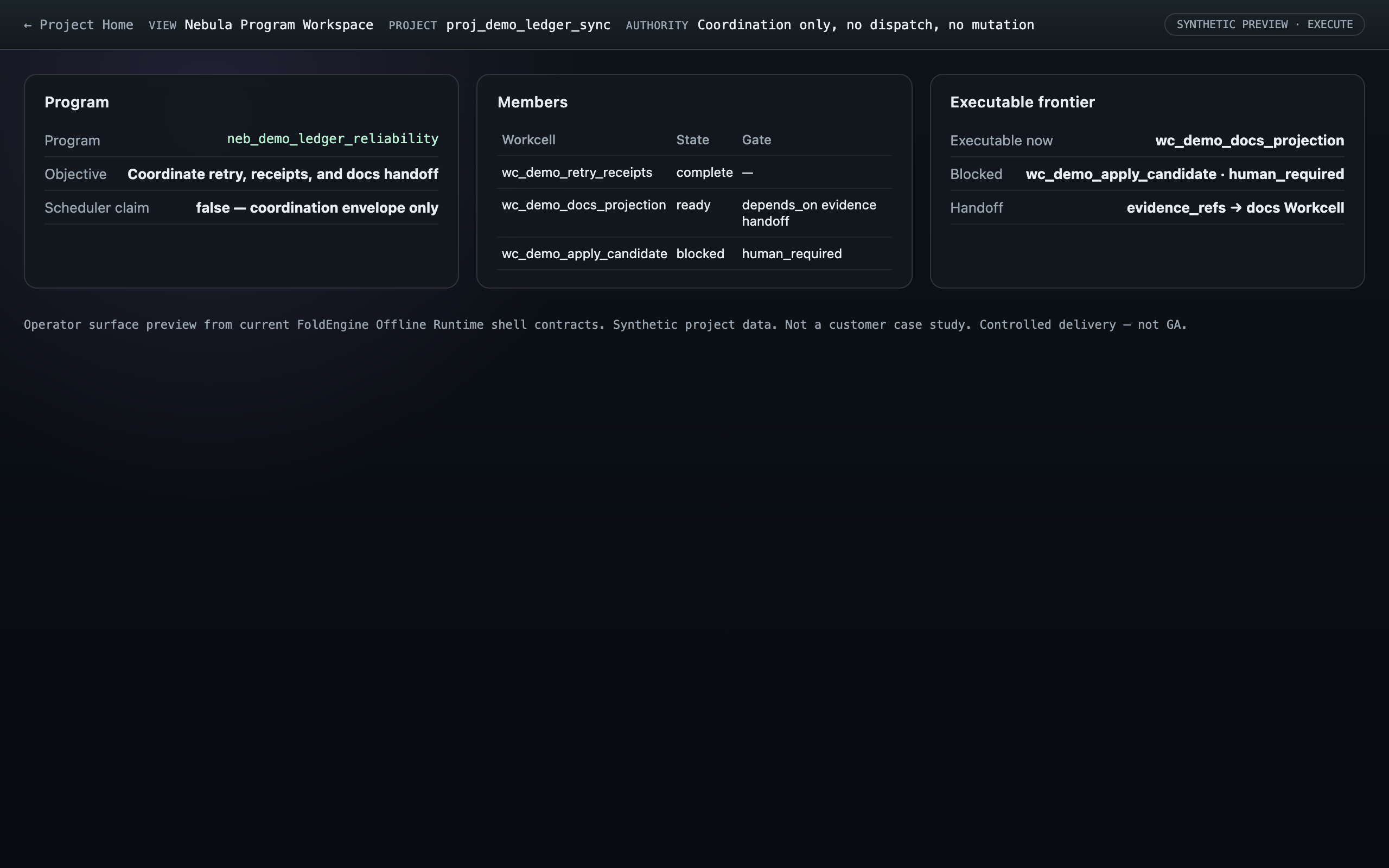
Executive Project Summary

Question: How do leads see portfolio posture inside Runtime?

Runtime surface: Organization Operations Center

Example output

  • Project status
  • Blockers
  • Review queue
  • Readiness
  • Next action

Why it matters: Operators see current posture without losing review boundaries.

Authority: Operational visibility. Not autonomous portfolio management.

Documentation projection

Audience-specific documentation candidates

FoldEngine can prepare audience-specific documentation candidates derived from governed runtime truth. Examples include:

  • Buyer Overview
  • Operator Guide
  • Executive Brief
  • Claims / Non-Claims Matrix
  • Website Copy Candidate

These remain candidate artifacts requiring human review. Publication remains human-controlled.

Next step

If these outputs look relevant, evaluate the runtime

Examples show the shape of the evidence, review surfaces, and candidate artifacts. The next commercial step is a governed repo diagnostic in your environment.