FoldEngine Stabilized.

Consequence-governance infrastructure · local-first · human authority at every boundary

FoldEngine is a governed engineering runtime for AI-assisted software work.

AI agents optimize for task completion.
FoldEngine governs whether work is allowed to become real.

FoldEngine understands repositories, constructs implementation plans, generates governed engineering candidates, validates work, preserves evidence, and improves through consequence memory — without autonomous execution or hidden approval.

Receipt Documented decision
Evidence What was checked
Uncertainty What remains unknown
Next step What happens if approved or held

Receipt. Evidence. Uncertainty. Next step.

Does not execute autonomously Review stays human-visible Execution authority absent by design

FoldEngine prepares candidates, evidence, and review surfaces. Humans still authorize apply, commit, push, merge, deploy, release, and publication.

Where to begin

Three entry depths

Entry diagnostic online, governed execution offline, and operations surfaces to manage work across projects — same governance logic, different depth.

  • Entry

    Trial Probe

    Hosted entry diagnostic. Submit a repo or project for a fast bounded report and a proceed/hold/block decision receipt with a recommended next step.

    Depth online diagnostic Output decision receipt Best for quick diagnosis
    Start a Trial Probe
  • Execution

    FoldEngine Runtime

    Offline operating environment for governed work. Guided deployment for teams that need isolated workcells, preserved evidence, formal review, and human-controlled delivery boundaries — without mutating source or granting execution authority.

    Depth offline workcell Foundation guided journeys + evidence Output candidates + receipts
    See FoldEngine Runtime
  • Management

    Operations surfaces

    Organization Operations Center and Project Workspace. Manage governed work across projects — review queues, evidence activity, blocked work, and environment readiness — without autonomous portfolio automation.

    Surfaces org ops + project workspace Focus portfolio posture Authority human review remains required
    See Runtime Preview
How to choose your path

Trial Probe is the fastest bounded diagnostic. FoldEngine Runtime is the offline operating environment for consequential work. Operations surfaces help teams monitor projects, review load, and readiness inside the same governed runtime. See FoldEngine Runtime.

Flagship walkthrough

Governed Repository Diagnostic

Follow one realistic first-month customer journey from mounted repository through construction, governed engineering, development packaging, validation, evidence, and review handoff.

Open the walkthrough →

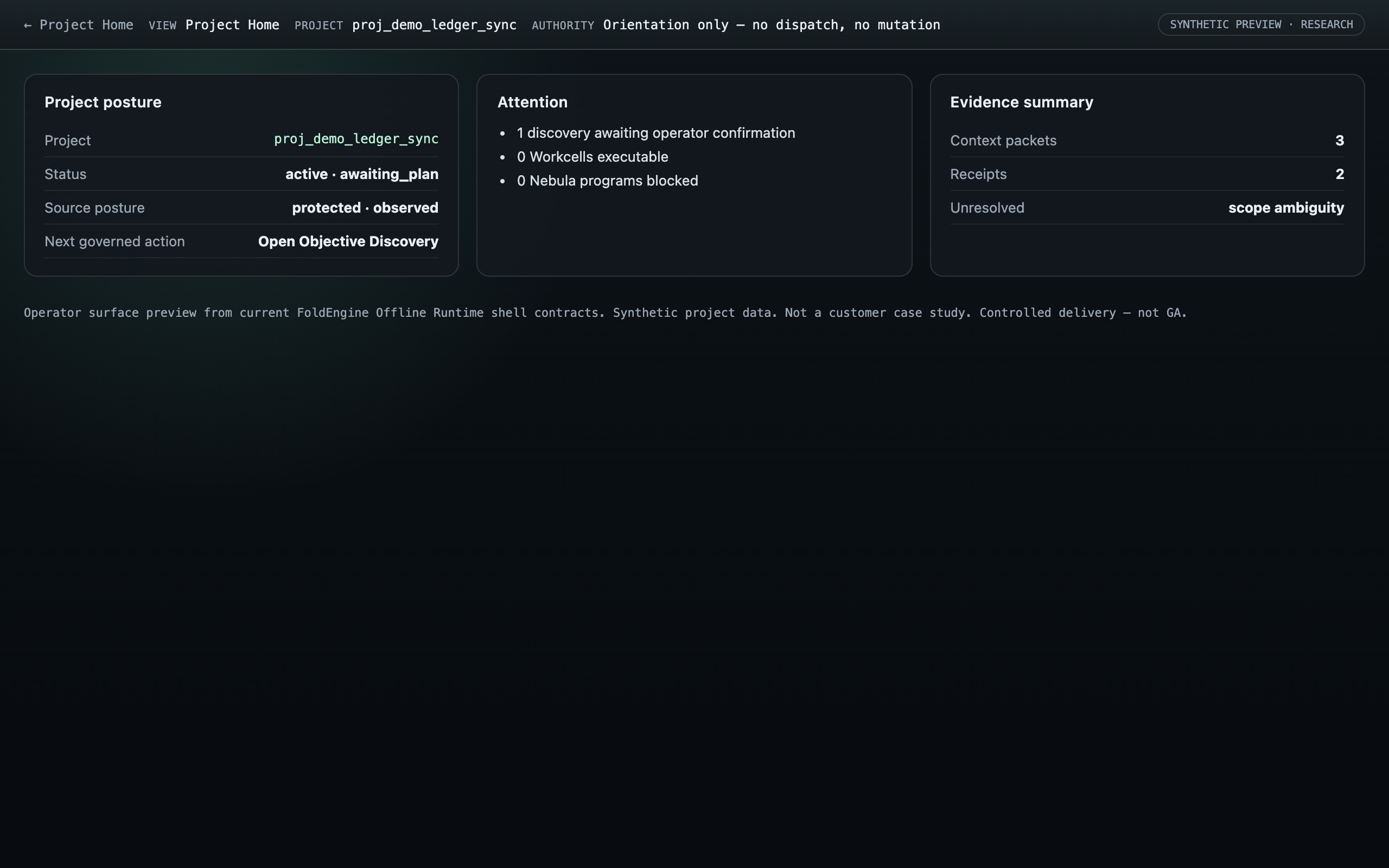
FoldEngine Runtime

Guided journeys inside FoldEngine Runtime

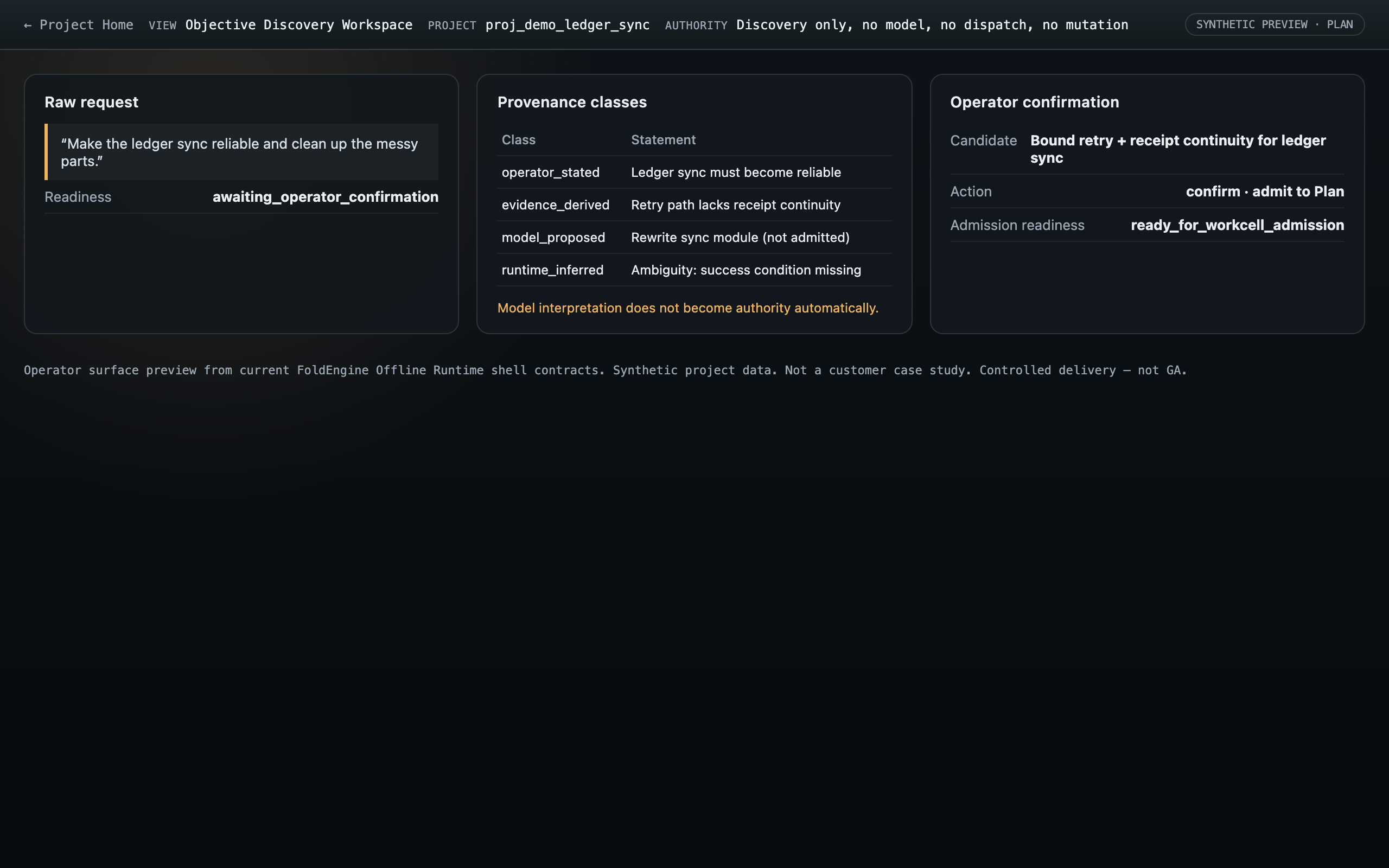
Customer tasks map to governed surfaces inside the offline operating environment.

Start a new project

New Project Guided Intake — shape requirements and hand off to construction.

Take over an existing repository

Repository Takeover Wizard — observe, test, and classify the next safe move.

Review construction package

Construction Workspace — inspect bounded build artifacts before review.

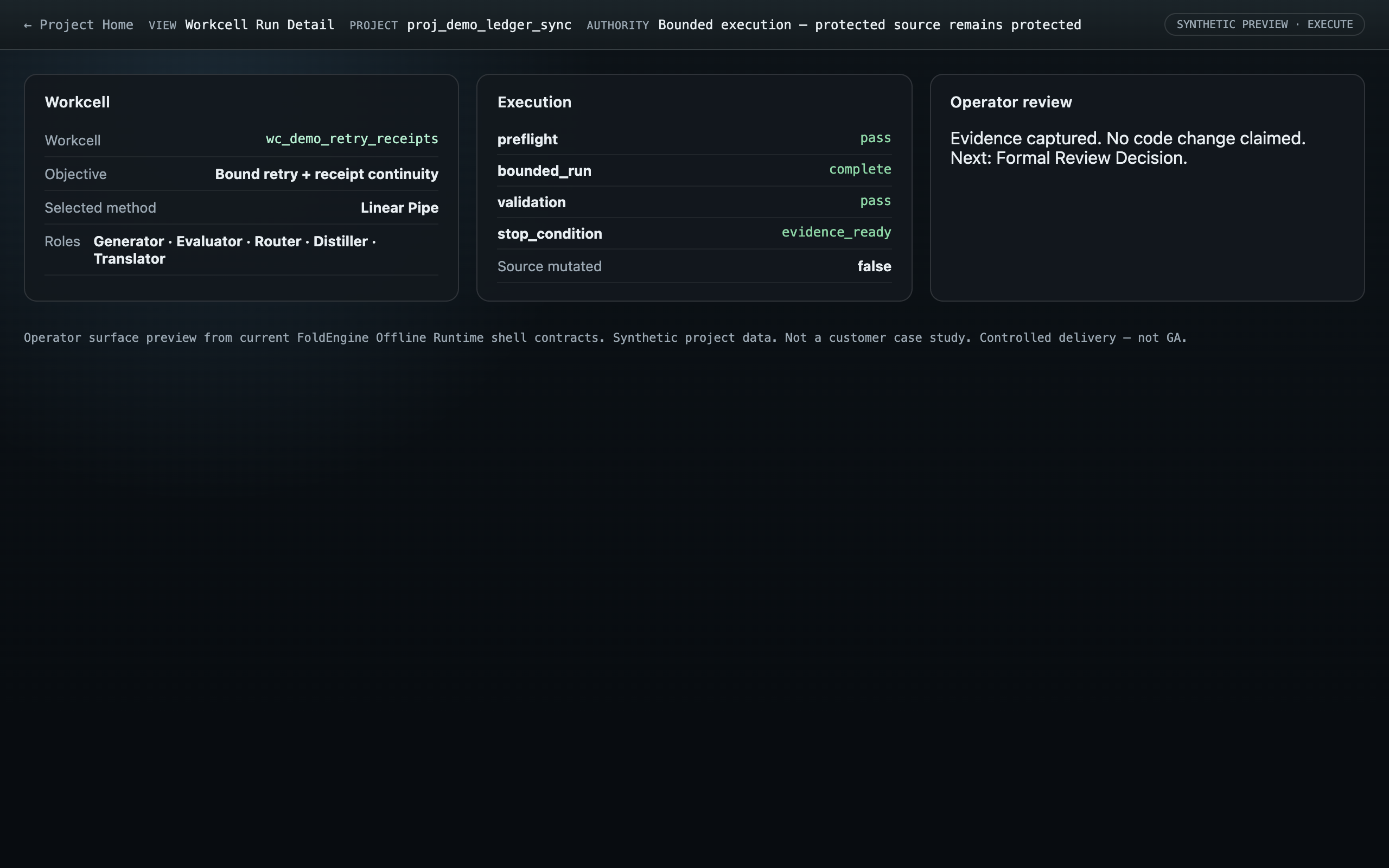
Trial bounded work

Workcell Run Detail — read-only evidence for a governed run.

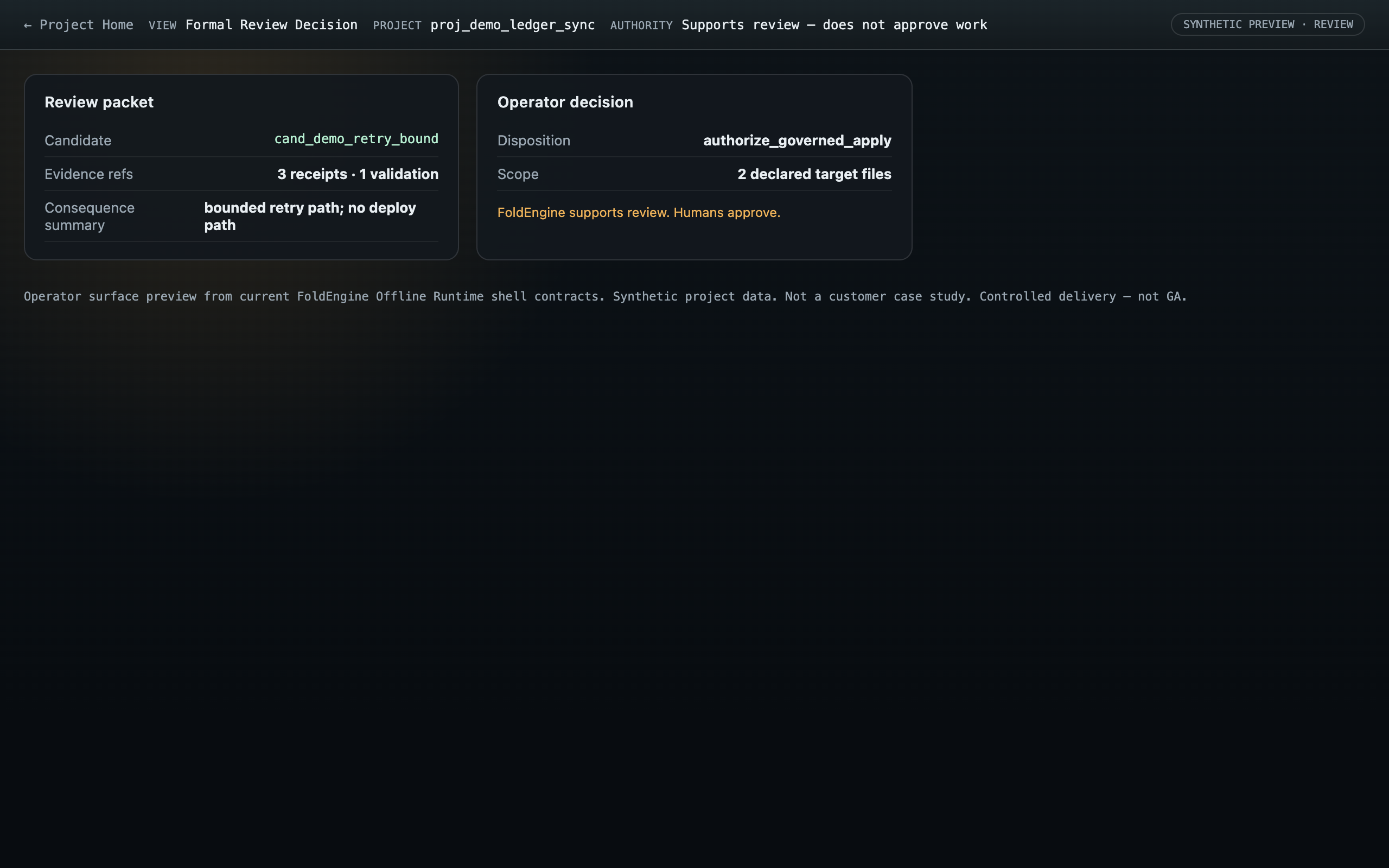
Make a formal review decision

Formal Review Decision — human review before the next boundary.

Inspect evidence and receipts

Evidence-backed workspaces with receipt summaries and inspectable proof.

Monitor projects and readiness

Organization Operations Center, Project Workspace, and Environment Readiness.

What the runtime actually does

Product demonstration, not broad AI promise

These are the four questions the product now answers directly for a buyer or evaluator.

1. What is FoldEngine?

A governed engineering runtime that understands repositories, shapes construction packages, generates governed candidates, validates bounded work, preserves evidence, and keeps human authority visible at every delivery boundary.

2. Who is it for?

  • Software organizations
  • Engineering teams managing multiple repositories
  • Teams adopting AI safely
  • Regulated or evidence-sensitive delivery environments

3. What problems does it solve?

  • Slow onboarding and repository complexity
  • Construction ambiguity and handoff friction
  • Weak review evidence and unsafe AI workflows
  • Knowledge loss, inconsistent engineering, and poor documentation continuity

4. What does the customer receive?

  • Construction packages and development candidates
  • Evidence packages and review packages
  • Projection graphs and governed validation
  • Organizational memory and clear next-step recommendations

Capability overview

Use the homepage for orientation. Use the deeper pages for detail.

The homepage should answer what FoldEngine is and what happens in a real first month. Architecture, subsystem detail, and implementation depth live on the dedicated pages below.

Customer and repository readiness

Customer readiness, environment posture, repository discovery, stack detection, toolchain gates, version checks, and repository conventions determine whether the next move is admissible.

Construction Workspace

Requirements, dependencies, acceptance, and projection become a bounded construction package before engineering work begins.

Governed engineering and development

Candidate work, validation plans, documentation updates, release notes, evidence plans, and review packages are prepared without widening authority.

Consequence Intelligence

Transition records, kernel discovery, kernel recall, organization memory, and recommendations improve future work while keeping evidence, review, and human apply as the final boundary.

Supported stacks

Mainstream stack support is visible and bounded

FoldEngine should explain current support honestly rather than implying universal autonomous repair.

Current supported or governed stacks

Python · Node · TypeScript · Go · Rust · Java · .NET · Ruby · PHP · Shell · C/C++ · SQL governed paths

Planned / explicitly not current

COBOL · Swift · Kotlin · Scala · Elixir are roadmap items only. They are not current product claims.

Adaptive governance

The right amount of governance per task

Not every task deserves the same depth of intelligence and assurance.

Before running, FoldEngine asks:

  • What project is this?
  • What resources and models are available?
  • What risk level does this task carry?
  • What did similar tasks cost or break before?
  • What does the operator prefer?

Then it recommends a governed path:

Minimal
Deterministic, low model cost. Low-risk or resource-constrained work. Pi 5 / offline-only / battery-sensitive.
Standard
Local model + decomposer + tests. Normal project work on Mac mini or server.
Expanded
Local proposal + critic/security advisory. Higher-risk changes requiring deeper review.
Restricted
Human-only, no model authority. When governance requires it.

Same governed workcell across all paths. Same operator authority at the consequence boundary. Same receipt format. Same consequence memory.

Project context comes first

Runtime does not simply point at a repo.

It first captures the project context: project type · source boundary · privacy posture · risk level · available models · operator preferences · prior consequence history.

That context becomes the strategy input. The strategy advisory recommends intensity. The governed workcell executes only within the allowed boundary.

How work arrives

Two ways a project arrives.

Bounded by evidence. Private by default. Recoverable across runs.

Online

Start with a Trial Probe

Submit a repo or project for a hosted bounded diagnostic. FoldEngine checks evidence, identifies the failure shape, and returns a proceed/hold/block decision receipt with a recommended next step.

Entry hosted intake Output decision receipt
Start a Trial Probe
Offline

Take over a stuck project

Bring a stuck local or offline project to FoldEngine Runtime. It captures project context, recommends the right governance intensity, coordinates bounded intelligence roles, runs candidate work only through the governed workcell, preserves evidence, and builds consequence memory — without mutating source or granting execution authority.

Entry local snapshot Output governed consequence + memory
See FoldEngine Runtime

One runtime, many functions.

You bring FoldEngine does
AI agent proposalClassifies, gates, receipts
Software changeBounds, trials, routes
Research claimEvidence-checks, gaps, bounds
Stuck projectSnapshots, classifies, recovers
Operational decisionReviews, receipts, remembers
Robot advisory planProjects, advises, gates

Closed-loop governance

The governance loop

Agents optimize for task completion. FoldEngine optimizes for governed consequence.

Local intelligence is role-governed, not agentic. LLMs suggest. Decomposers sense. Critics review. Security roles flag risk. The governed workcell executes. The operator authorizes irreversible action.

Strategy recommends. Workcell executes. Operator authorizes. Evidence preserves. Memory derives.

Does not execute.

In the offline governance runtime, this pattern is used across local runtime health, node/model roles, local surfaces, folders, services, repository state, pull-request metadata, CI/CD gate metadata, ticket/workflow metadata, security findings, compliance/export requests, and the relationships between them.

Observe / diagnosis

FoldEngine identifies the risky seam before it turns into a real consequence.

Classify / gate

It checks the evidence, names what is missing, and shows whether the next move is ready, risky, or blocked.

Candidate / receipt

The proposed next step becomes a reviewable record, with evidence, uncertainty, and the reason it was held or advanced.

Review / continuity / next run

Review, continuity, and the next move stay visible, while execution authority stays with the operator.

How FoldEngine works

Trial Probe is the fastest way to understand a project in its current state. FoldEngine Runtime is the deeper offline environment for teams that need evidence, review, continuity, and careful control before work crosses into the real world.

Runtime preview

See the Runtime Preview.

Explore three public demonstrations: the Runtime Preview, the Physical Consequence Simulator, and the Evidence & Memory Explainer.

  • Runtime Preview

    See how FoldEngine approaches stuck-project recovery, new-project intake, and consequence memory in a guided public preview.

    Open Runtime Preview →
  • Physical Consequence Simulator

    See how a proposed action is checked before it is allowed to become a real-world consequence.

    Open simulator →
  • Evidence & Memory Explainer

    See how receipts, lineage, and memory stay connected without taking authority away from current evidence or human review.

    Open explainer →

Public demonstrations only. No live repo access, no source mutation, and no autonomous execution.

Works with your toolchain

FoldEngine is the governed decision layer — not another scanner.

Tooling Good at FoldEngine adds
AI coding agents & IDE review Speed, suggestions, day-to-day coding flow False-closure check before build-on, demo, ship, or handoff decisions — with governed delivery
RAG / ask-my-repo Exploratory Q&A from retrieved context Bounded verdict — supported findings, evidence gaps, boundary notes, named next move
MCP & connected tooling Evidence access across systems Governance — which question to ask, which claims are allowed, what history to preserve
SAST & dependency scanners Continuous signals, CVEs, policy checks Decision framing for a specific moment plus ledger continuity across repeated reviews

Use your everyday AI stack for velocity. Use FoldEngine when the decision is weight-bearing.

Start simple

Trial Probe is the fast online entry point. FoldEngine Runtime is the deeper offline environment for teams that need reviewable work, preserved evidence, and careful control before delivery consequences become real.

Already assigned? Sign in to the client portal to view current project status.

FAQ

What is Trial Probe vs FoldEngine Runtime?

Trial Probe is the fast online entry point. It gives you a clear view of what the evidence supports and what should happen next. FoldEngine Runtime is the deeper offline environment for teams that need context-aware review, isolated work, preserved evidence, and careful control before change crosses a real delivery boundary.

What does FoldEngine do with a stuck project?

It takes in project context, recommends the right level of review, runs work inside a contained environment, and preserves the evidence trail around what happened. It does not commit, push, merge, deploy, or release on its own. Human authority remains in place at every consequential boundary.

How is this different from AI code review?

Most AI review tools help you move faster inside the workflow you already have. FoldEngine helps you decide whether important work is actually ready to move forward, with evidence, review, and a preserved record of what was decided.

Does FoldEngine execute autonomously?

No. FoldEngine does not mutate source, commit, push, merge, deploy, or release anything. Providers do not hold authority. No memory-based authority override. The operator remains in authority at every consequence crossing. FoldEngine governs consequence — it does not execute autonomously.